

My ex-wife said something to me years ago that I think about to this day. She said knowing yourself is like breathing. If you know who you are, you don’t even think about it. It just happens. You move through the world as yourself without monitoring every choice, every word, every room you walk into.
But what if you don’t know who you are?
Then it’s like having to consciously think about every breath you take. Inhale. Exhale. Am I doing this right? Is this the right rhythm? What if I stop? What if I do it wrong?
She could see what I couldn’t. That for thirty years, I had been paying attention to my breathing.
I built my entire personality out of other people’s blocks.
Their preferences became my preferences. Their comfort became my priority. I calibrated to what everyone else needed so well that I couldn’t have sooner told you what I wanted for dinner, let alone what I wanted from my life.
I had no signal. The channel where my own wants were supposed to broadcast had been off the air so long I forgot it existed.
For some people this is occasional. A moment here and there. For me it was the operating system. I didn’t just accommodate — I scanned. Every room, every conversation, every relationship. There was a constant background calculation running: what does this person need me to be? And I’d become it. Not as a decision but as a reflex. I didn’t even notice I was doing it because I’d never known myself without it.
Where I was is when the performance runs so long and so deep that you lose the original signal entirely. Where you can be in a relationship for ten years and your partner has never met you — not because you’re hiding, but because what’s behind the performance has atrophied.
In that relationship, every decision ran through a background process. Not always for them — for me. Every choice filtered through a single question: will this keep me accepted? Not what do I want. Not what do I think. Will this keep me safe. Will this let me fit. It wasn’t generosity. It was a monitoring system I couldn’t turn off.
Even though I didn’t want it. Even though I was in therapy. Even though I understood the pattern completely.
And nothing changed.
That’s the gap nobody talks about. Not a gap in knowledge. A gap in proof. I had decades of evidence that the performance worked — that I fit in, that I stayed safe, that relationships held together. And I had zero evidence that I could function without it. Not a single data point that said: you can drop this and survive.
Understanding tells you what’s wrong. But your nervous system doesn’t update through understanding. It updates through proof. Through experience. And I had none.
You can’t think your way out of an action problem. I tried for thirty years.
Nobody tells you that when you finally stop performing, the first thing you feel isn’t freedom.
It’s a void with nothing to grasp at all.
When the performance dropped and the relationship ended and the structure I’d built my identity around fell away — what was underneath wasn’t some authentic self waiting to emerge.
It was blank. Empty. Not emptiness as a flaw. Emptiness as an absence. The absence of anything I’d built myself.
Instead of a personality, I developed a survival strategy. And when the survival strategy was no longer needed, what was left was the space where a self was supposed to be. Thirty years of proof that the performance works. Zero proof of who I am without it.
What I knew was that my dad had just died weeks prior, my marriage was ending, and I didn’t even know where to begin.
I could have kept doing the same things I’d been doing — the safe things, the familiar things, the things that didn’t ask me to be anyone in particular.
But something in me needed to move. Not in a travel sense. In a personal one. I didn’t feel fear as much as opportunity. Or maybe something in me was just finally ready — not me, exactly. It.
So I booked a solo camping trip to Washington state for two weeks all alone. It became the most important choice I could make at that point in my life.
My trip fell apart before it began.
My rental camera gear to document this wonderful adventure didn’t arrive in time. After landing in Washington my phone was at two percent and without a charger that worked. My first stop wasn’t going to be what I wanted, but to wherever I could find a retail store.
Various other issues compounded into one idea: I shouldn’t be here. What am I doing here?
I cried. In the car sitting in the rental lot. Within the first hour.
This was supposed to be a good trip. And instead, my first stop wasn’t a trailhead or a campsite. It was Best Buy.
I wanted to go home. Genuinely. Within sixty minutes of landing, I wanted to turn around and leave. It was the reaction of someone whose life was currently attached by string and scotch tape. Whose life of accumulated nothing was a mess. Who had never made a single significant choice for himself and was now sitting in a parking lot three thousand miles from home wondering what the hell he was doing.
Some time later, I composed myself, did what I needed to do and drove on.
The trip became about choices. Not big, dramatic, story-worthy choices. Small ones. The kind nobody writes about because they don’t sound like anything.
This sounds stupid unless you’ve spent your entire life scanning for what other people want. When picking for yourself and sitting with it isn’t an act of defiance or courage — it’s an act of developing proof.
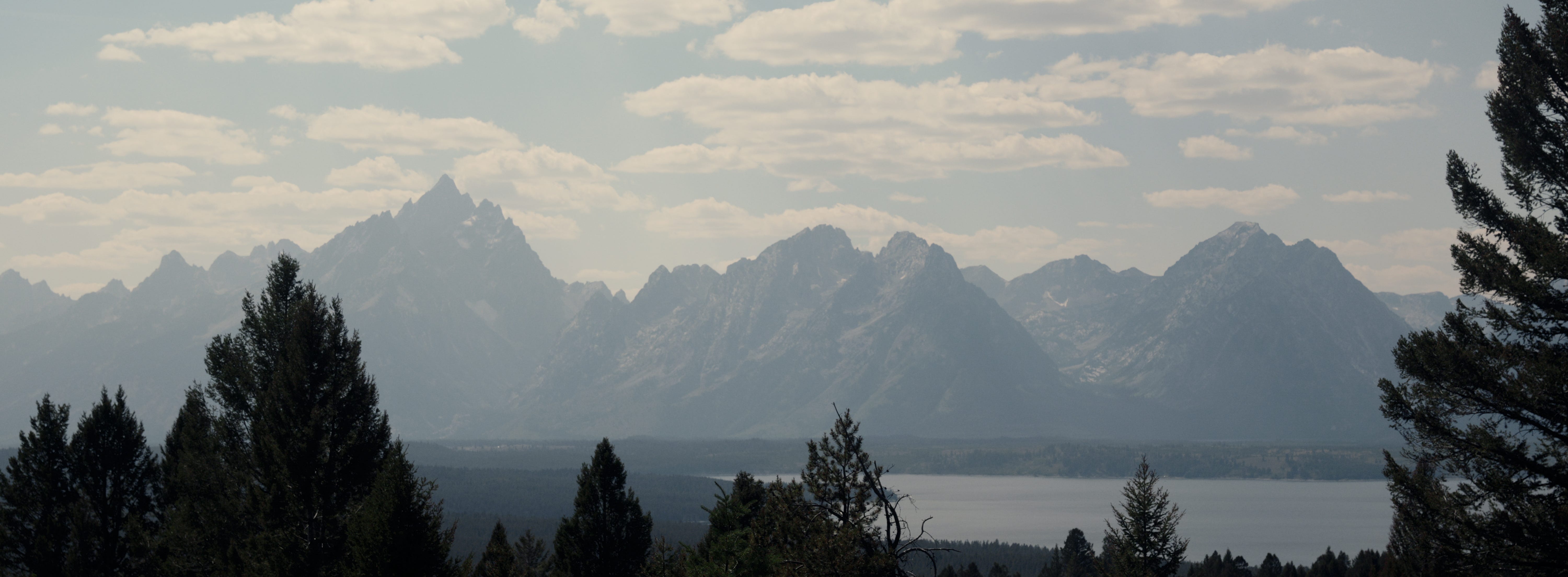
I went camping because my dad used to take me as a kid. And while we were only starting to get close in adult life, he’d passed away only recently before this trip. I was carrying his death, my separation, and my own unraveling all at the same time — and I chose to sleep in the woods because it was the closest connection with nature and a territory I loved that I could come up with.
I went skydiving. I went whitewater rafting. And while those were fun and scary, those aren’t the moments that built anything lasting. The foundation wasn’t laid by the electrifying stuff. It was laid by the quiet, unglamorous, compounding choices that don’t make good stories.
I picked a new campsite every night to maximize travel distance and coverage. It seemed like making the most of the trip. And I hated it. I couldn’t rest after a long eventful day. I had to set up at night and in the morning I had to pack. I was at the whim of my travel ambitions rather than my desire to rest in the moment. I didn’t know that about myself until I was too tired to ignore it.
One night I slept in a hammock because that’s where the trees allowed it. It turns out I love sleeping in a hammock. It also turns out it’s important to set up the hammock appropriately or else you find yourself with a cold ass on the ground at two in the morning. But that was mine. A preference discovered and taken seriously because I was the only one there to have it. Not borrowed. Not performed. Not filtered through what anyone else would think. I liked it. That was enough.
I picked wrong sometimes. I’d get something and not like it. And that — “I don’t like that” — was information. Real information. Mine. A preference that belonged to me because no one else was there to meaningfully influence my take.
What to eat. Where to turn. When to stop. Whether to stay.
Those were my building blocks. My own, for the first time.
Coming back from San Juan Island I was in tears. Not from pain. From gratitude. Something had opened up over those days and I was so full of it I couldn’t hold it together on the ferry.
Then I pulled into a gas station.
A guy at the next pump started telling me about his latest surgery. In rich, committed detail. His entire arm felt like being wrapped in barbed wire, he said. An electrical current running through it. Ten minutes I stood there nodding. “Wow, man. Yeah. That’s crazy...”
Out of... Well, for some damn reason I didn’t know how to leave. Here I was mid-breakthrough, crying with gratitude an hour earlier, and I was still stuck in this Midwest Goodbye.
Honestly I think I was mostly flabbergasted.
I didn’t have this language then. But I think what was happening is that every choice I made on that trip was a deposit of proof my nervous system had never had.
The right choices built something I’d later understand as competence evidence. Proof that my own judgment could lead me somewhere worth going. That I could pick a trail and it would be beautiful. That I could sleep in a hammock in the woods and discover something I genuinely loved. That I could decide to stay somewhere longer or leave earlier and both would be fine.
The wrong choices built something I didn’t expect, and it might matter more. Tolerance evidence. Proof that a bad call wouldn’t destroy me. That I could pick a new campsite every night and learn the hard way that I need rest more than coverage — and still be standing. That I could drive an hour in the wrong direction, eat something I hated, wake up cold on the ground — and still be okay. Not perfect. But functional. Alive.
The fear underneath people-pleasing was never really “what if they don’t like me.” It was “what if I make the wrong choice and I can’t survive it.” Every wrong choice I survived on that trip quietly disproved that.
I’d had decades of proof that performing for other people kept me safe. And now I was collecting new proof. One meal, one trail, one wrong turn at a time.
The old proof wasn’t erased. The new stuff just slowly became louder.
That’s what evidence-based change actually is. The proof accumulating quietly, unglamorously, one choice at a time until it outweighs the fear. Until your nervous system has enough data.
Understanding tells you what’s wrong. Proof tells your body it’s safe to change. I understood my people-pleasing for thirty years. What I was missing was the proof that I could exist without it.
I couldn’t tell you I’d found myself when I came home. That would be a lie.
This was the foundation of starting to build myself. Out of my own materials, for the first time.
What followed was years of continued choosing. Continued collecting proof. Continued catching myself mid-performance and choosing differently. Sometimes successfully, sometimes not. Sometimes at gas stations, still nodding along.
Growth is a process, not an end. And the distance between that parking lot where I cried over a dead phone and where I am now isn’t a straight line. It’s years of getting it wrong and getting it right and slowly, slowly accumulating enough proof that something shifted.
There’s an unappreciated beauty to making your own choices. Like how I wrote this to the same album I listened to on repeat during the trip — Carly Rae Jepson’s “Emotion.” That one is mine, too.
I think about my ex-wife’s words differently now.
She said knowing yourself is like breathing. And for a long time, my personality was a conscious, monitored, effortful performance of what I thought would be accepted. Every breath deliberate. Every exhale calculated. Inhale. What do they need? Exhale. What do I become for them?
That shift didn’t come from more understanding. It came from proof.
I don’t have to think about my breathing anymore. I think that’s because my body finally has enough evidence that I can be trusted with my own life.
I’m still building. I’m still collecting. I still catch myself holding my breath sometimes.
But I don’t monitor it anymore.
And that is the most peaceful part of my life.